
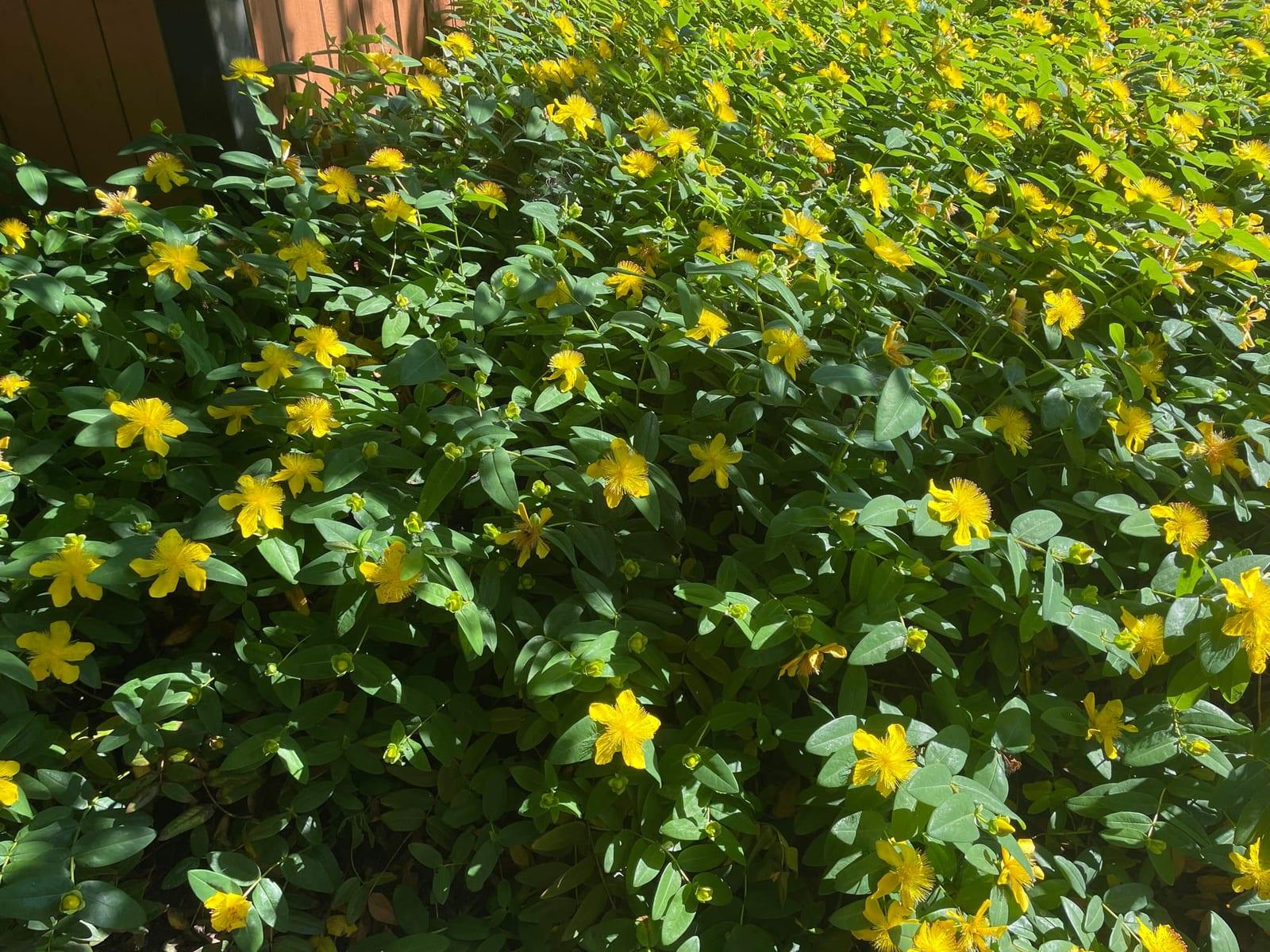
Creeping St. John's wort is a low, mat-forming shrub, 12 to 18 inches high, with evergreen to semi-evergreen leaves and 3-inch golden flowers, each with a brush of stamens, through summer. Red-brown seed capsules follow. It is native to southern Europe and southwest Asia and has been a ground cover in gardens for two centuries.
It earns its keep on dry banks and in dry shade where little else grows, and it knits together fast. That speed is the catch: it runs by rhizomes and stolons and will cover more ground than you gave it, and in mild climates it escapes into woodland. Give it a hard boundary, or plant it where a mower or edging can hold the line, and do not plant it next to anything smaller.
Plant 18 to 24 inches apart in sun or part shade, in any soil that drains, and water only until it is established. Mow or shear the whole planting to a few inches in late winter every year or two; it comes back dense and flowers on the new growth. Bumblebees work the flowers for pollen. Deer leave it alone, and rust on the leaves in a wet summer is cosmetic.
These dates are for Zone 6b. Enter your ZIP to time every job to your own frost dates.
- cut · Mar 27Shear or mow to a few inches before growth starts to keep the mat dense
- watch · Any time in springConfirm the spread has a boundary; cut runners back at the edge of the bed
- watch · Any time in summerEnjoy large golden-yellow flowers with showy stamens
Problems & troubleshooting
Common problems
Rust
Orange to brown raised pustules on the undersides of leaves, with yellow spotting on the upper surface. Heavy infections cause leaves to yellow and drop.
Remove and destroy infected leaves. Avoid overhead watering and improve air circulation. Apply a sulfur or copper-based fungicide if it spreads. Clear plant debris in fall.