
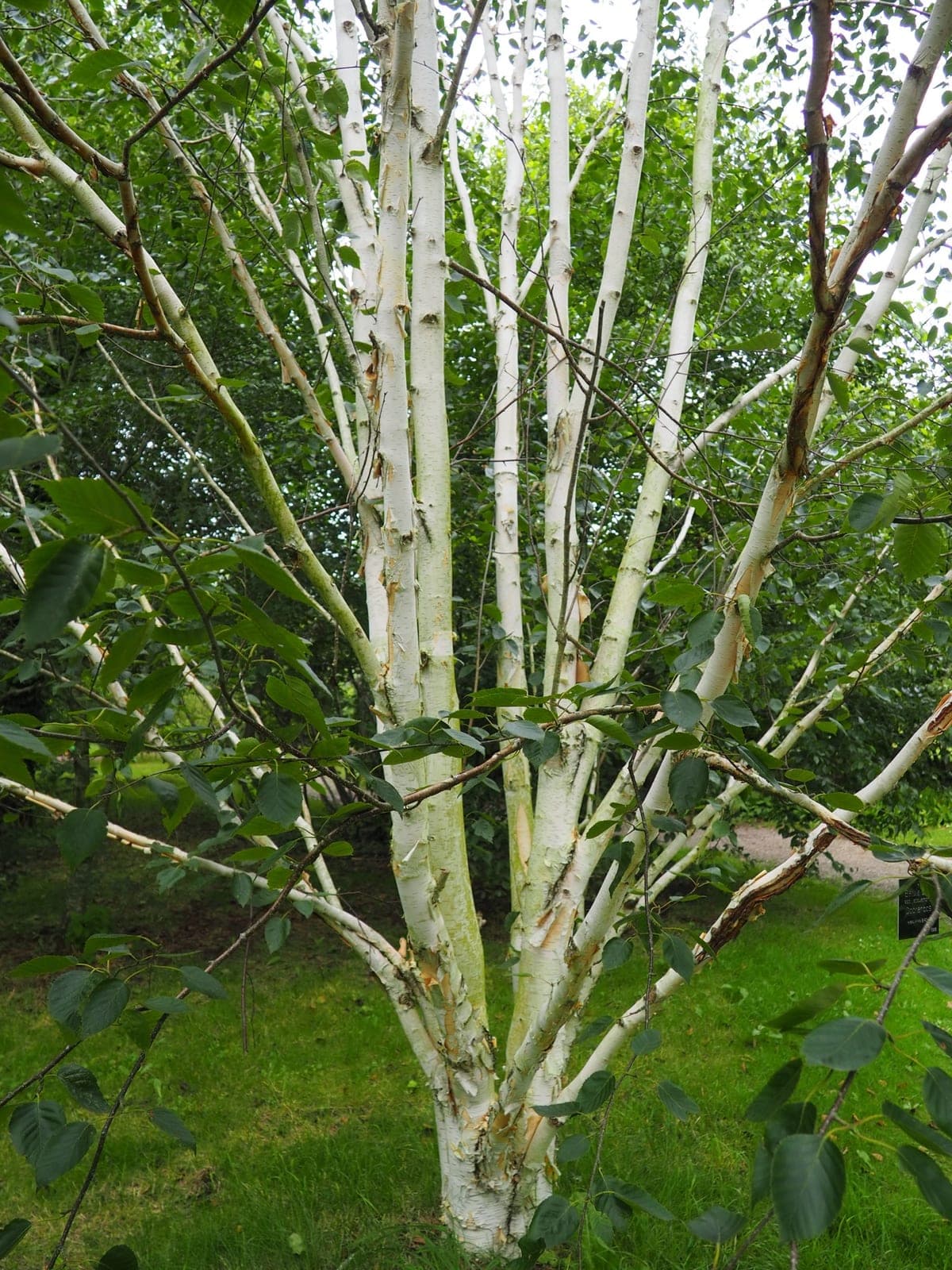
Himalayan Birch is grown principally for its chalk-white, papery, peeling bark - among the brightest of any tree in cultivation. Native to the western Himalayas from Kashmir to Nepal, it typically reaches 30–50 ft and fits small to medium landscapes. It holds interest across all four seasons: spring catkins and emerging foliage, summer canopy, golden fall color, and a luminous white winter silhouette.
Grows best in cool climates with consistent moisture and good drainage. In zones 6–7, afternoon shade reduces heat stress and extends tree vigor. Multi-stem specimens expose the most bark surface and are the most widely planted form. Bronze birch borer is the primary threat in North America; drought-stressed trees are most vulnerable. A soil pH of 5.0–6.5 is ideal. Apply 3–4 in of organic mulch beyond the drip line and avoid planting in compacted clay or heat islands. Bark whitens appreciably within a few growing seasons; removing lichen or algae with a soft damp cloth improves the winter display.
Bark of Betula utilis served for centuries as a writing substrate - Sanskrit manuscripts on birch bark survive from the Himalayan region. In Ayurvedic and traditional Himalayan medicine, the bark is used to treat skin disorders and fever. It contains betulin and betulinic acid, compounds with documented anti-inflammatory activity and ongoing research interest for antimicrobial properties.
Fungal leaf spot
Brown or purplish spots on the leaves, often ringed with a yellow halo, that spread and merge in warm, humid, or wet weather; heavily spotted leaves yellow and drop early.
Pick off spotted leaves and clear fallen debris to remove overwintering spores. Improve air circulation by thinning, and water at the base so foliage dries quickly. If it persists, apply a copper- or sulfur-based fungicide at the first sign.
Cytospora Canker
White or blue-white pitch masses ooze from bark on lower branches and the trunk. Affected branches die back progressively from the tip inward; bark beneath the resin is discolored brown and may have a resinous, sunken appearance.
Prune infected branches well below the canker margin into healthy wood and destroy all cuttings. Sterilize pruning tools with 70% isopropyl alcohol between each cut. No effective fungicide is available; prevent recurrence by avoiding drought stress, soil compaction, and mechanical bark injury.
Armillaria Root Rot
Thinning, yellowing canopy with progressive dieback; white, fan-shaped mycelial mats visible beneath bark at or just below the soil line; honey-colored mushroom clusters appearing at the trunk base or on surface roots in autumn.
No chemical cure exists. Improve drainage and avoid any injury to roots or trunk. Remove severely infected trees along with as much root material as possible. Do not replant susceptible species in the same spot.
Birch Witches' Broom
Dense clusters of abnormally short, twiggy shoots arise from single branch points, forming persistent broom-like masses visible year-round. Affected shoots produce undersized, sometimes reddish-tinged leaves. Brooms remain as bare, conspicuous structures through winter.
Prune out witches'-broom clusters in late summer or fall, cutting at least 6 in below the broom base into healthy wood. Disinfect tools between cuts with a 10% bleach solution. No chemical controls are reliably effective; maintaining tree vigor through consistent watering, mulching, and avoiding compaction reduces recurrence.