
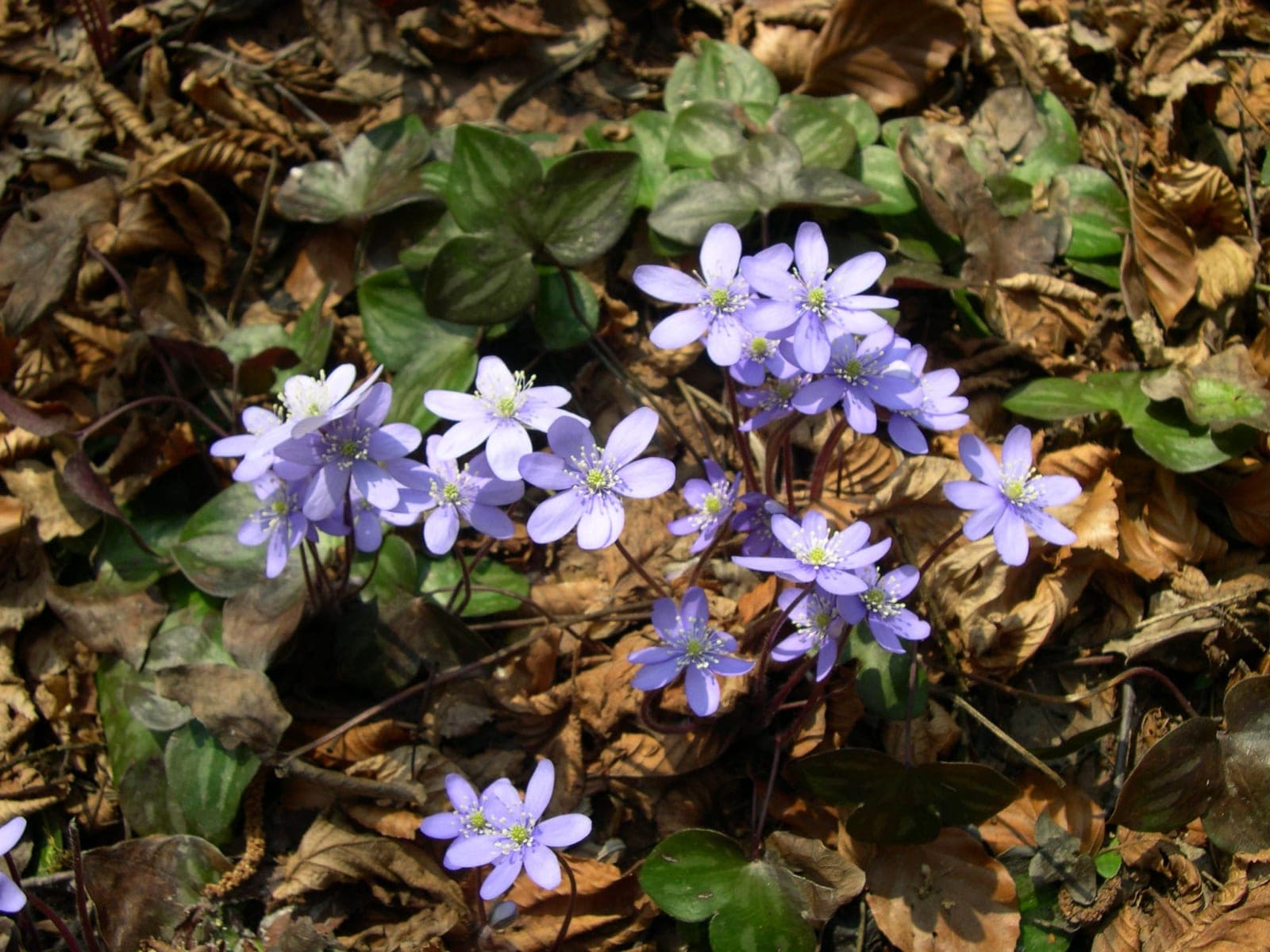
Hepatica nobilis is a low-growing woodland perennial in the buttercup family, native across temperate Europe and Asia. It produces small, many-tepaled flowers in white, pink, lavender, or blue in very early spring - often while frost is still in the ground - making it among the first wildflowers of the year. The three-lobed leaves are semi-evergreen, persisting through winter and giving the plant its common name.
Hepatica grows slowly from a fibrous rhizome and strongly dislikes root disturbance once established. It thrives in dappled to deep shade under deciduous trees, where it naturally colonizes humus-rich, slightly alkaline soil. Top-dress annually with decomposed leaf litter to replicate woodland duff; bark mulch is a poor substitute. Plants self-seed slowly in favorable spots and take three to four years from seed to first bloom. Established plants are reliably cold-hardy through zone 4 winters.
The name reflects the doctrine of signatures: the three-lobed leaves were interpreted as resembling a liver, leading to centuries of use in European herbalism for liver and kidney complaints. The plant contains protoanemonin, an irritant compound common to Ranunculaceae, and historical medicinal applications have not been validated by modern clinical research.
Fungal leaf spot
Brown or purplish spots on the leaves, often ringed with a yellow halo, that spread and merge in warm, humid, or wet weather; heavily spotted leaves yellow and drop early.
Pick off spotted leaves and clear fallen debris to remove overwintering spores. Improve air circulation by thinning, and water at the base so foliage dries quickly. If it persists, apply a copper- or sulfur-based fungicide at the first sign.
Crown Rot
Lower leaves yellow and wilt; the base of the rosette turns brown and soft, sometimes with white fungal threads at the soil line. Plants collapse in wet conditions.
Remove and destroy affected plants. Improve drainage and avoid overhead watering. Do not mulch directly against the crown. Space plants for airflow and avoid replanting in the same wet spot.
Foliar Nematode
Angular brown or black patches on leaves, bounded by leaf veins, starting on lower foliage and moving upward. Affected leaves wither but stay attached.
Remove and destroy infected leaves and surrounding debris. Avoid overhead watering and wetting foliage. Space plants for airflow and do not compost affected material. Severely infested plants should be dug out and discarded.