
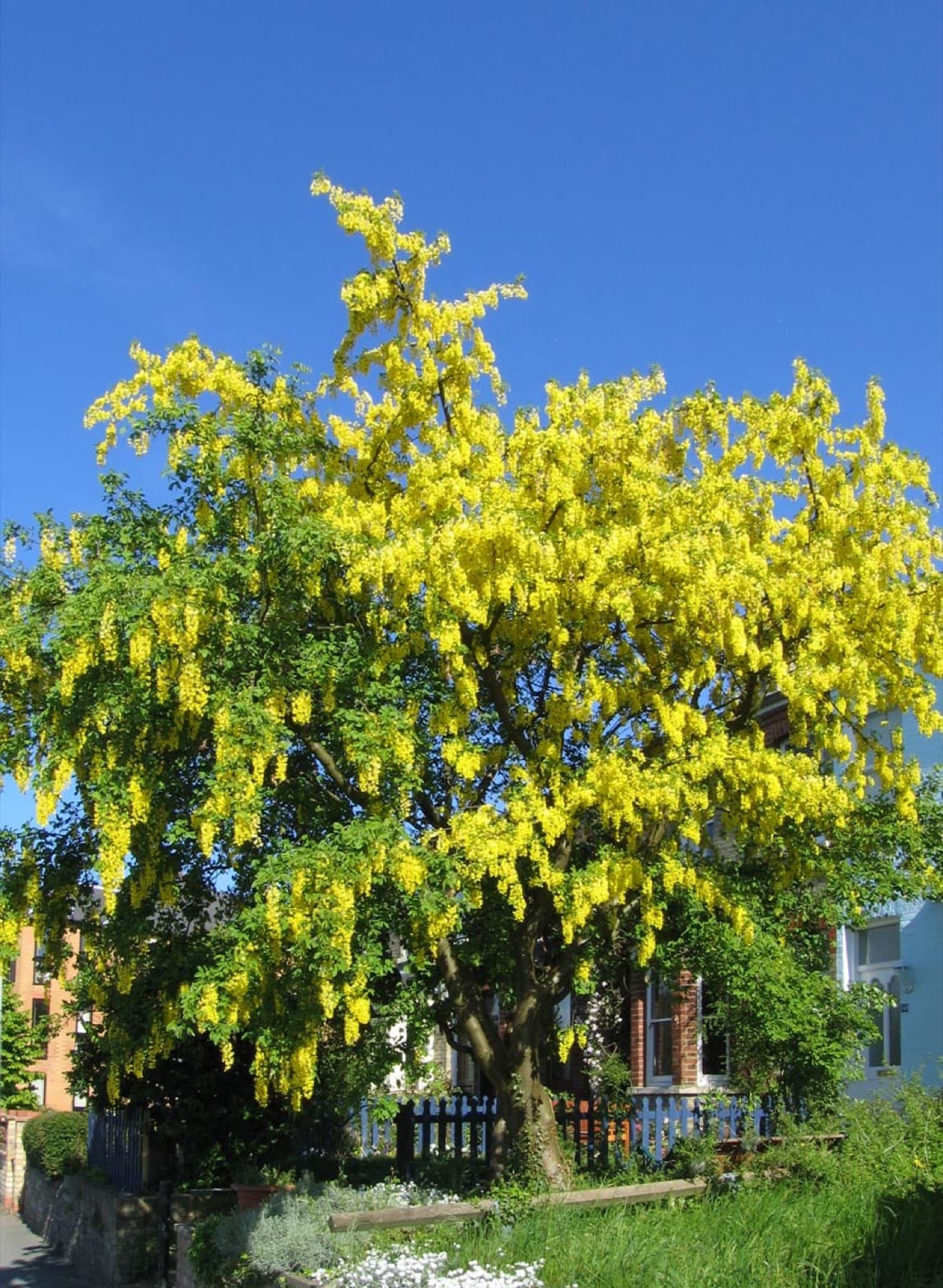
Laburnum anagyroides is a small deciduous tree native to central and southern Europe, grown for its long, pendulous chains of bright yellow flowers that appear in late spring. It works as a specimen tree or trained over a sturdy pergola to form the classic laburnum tunnel seen in historic British and European gardens. Despite reaching only 15–25 feet, it delivers strong visual impact relative to its footprint.
It thrives in well-drained, neutral to alkaline soil and tolerates chalky ground that defeats many other trees. Waterlogged conditions cause decline. As a legume, it partners with nitrogen-fixing soil bacteria, keeping fertility requirements low. Every part of the plant is toxic-particularly the pea-like seeds-so remove pods before they ripen where children or livestock have access. Prune immediately after flowering and only on dry days to minimize silver leaf infection risk. Plants are relatively short-lived at 25–40 years and perform poorly in hot, humid summers, which limits the range to zone 7b and below.
The heartwood is exceptionally dense and was historically used for musical instrument components (recorder bodies, wind-instrument keys), tool handles, and fine cabinetwork. The alkaloid cytisine, concentrated in the seeds, is the active compound in Tabex, a smoking cessation pharmaceutical that has been evaluated in randomized clinical trials.
Powdery mildew
White or grey powdery coating on leaves - usually starting on older growth in humid conditions or when nights cool.
Improve air circulation by thinning plants. Apply neem oil or potassium bicarbonate spray at first sign. Avoid overhead watering.
Armillaria Root Rot
Thinning, yellowing canopy with progressive dieback; white, fan-shaped mycelial mats visible beneath bark at or just below the soil line; honey-colored mushroom clusters appearing at the trunk base or on surface roots in autumn.
No chemical cure exists. Improve drainage and avoid any injury to roots or trunk. Remove severely infected trees along with as much root material as possible. Do not replant susceptible species in the same spot.
Fungal leaf spot
Brown or purplish spots on the leaves, often ringed with a yellow halo, that spread and merge in warm, humid, or wet weather; heavily spotted leaves yellow and drop early.
Pick off spotted leaves and clear fallen debris to remove overwintering spores. Improve air circulation by thinning, and water at the base so foliage dries quickly. If it persists, apply a copper- or sulfur-based fungicide at the first sign.
Silver Leaf
Leaves on affected branches develop a distinctive silvery sheen as fungal toxins (produced by Chondrostereum purpureum) separate the upper and lower leaf layers; infected branches die back progressively; cross-sections of dying wood show dark brown internal staining.
Remove affected branches at least 6 inches below the lowest visible internal staining; prune only in dry weather to reduce airborne spore entry into wounds; dispose of all infected wood off-site or burn it; no effective fungicide exists once the pathogen is established inside the wood.