
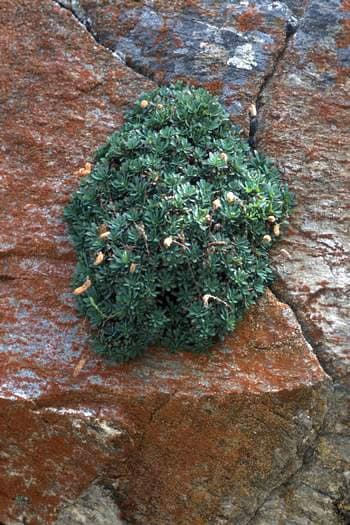
Petrophytum cinerascens is a rare mat-forming subshrub in the rose family, endemic to a small number of basalt cliff and talus sites along the Columbia River in Chelan and Douglas Counties, Washington. In cultivation it serves as a specialty rock garden plant: tight, ash-gray-green foliage presses flat against stone surfaces and produces short white flower spikes in summer.
In the wild it occupies near-vertical rock faces and scree with exceptional drainage, full sun, and virtually no organic matter. Replicating those conditions-coarse grit or crushed stone substrate, near-neutral to slightly alkaline pH, and zero water-holding capacity around the crown-is the key to long-term success. Average garden soil or any consistent moisture causes crown rot quickly. Once established, it is extremely drought tolerant and needs almost no intervention. It is a slow grower and should not be expected to fill space quickly.
The wild population is very small and the species is considered rare. Source plants only from nurseries propagating from cultivated stock; do not collect from the wild.
Crown Rot
Lower leaves yellow and wilt; the base of the rosette turns brown and soft, sometimes with white fungal threads at the soil line. Plants collapse in wet conditions.
Remove and destroy affected plants. Improve drainage and avoid overhead watering. Do not mulch directly against the crown. Space plants for airflow and avoid replanting in the same wet spot.
Root rot
Plants wilt, yellow, and stunt even in moist soil; lower stems and roots turn brown, soft, and mushy and the plant may collapse. Most common in heavy, wet, or poorly drained ground.
Improve drainage and stop overwatering, and never plant too deep. Lift and destroy badly affected plants along with the soil around the roots. Grow in raised or free-draining beds to prevent it returning.
Powdery mildew
White or grey powdery coating on leaves - usually starting on older growth in humid conditions or when nights cool.
Improve air circulation by thinning plants. Apply neem oil or potassium bicarbonate spray at first sign. Avoid overhead watering.