
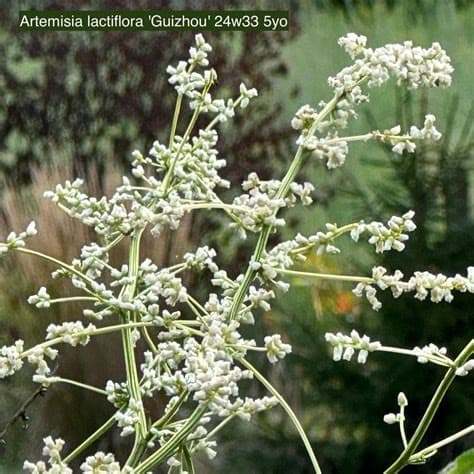
The 'Guizhou' Group of Artemisia lactiflora - commonly called Ghost Plant or purple-leaved white mugwort - was collected in China's Guizhou province during a joint 1985 expedition by the Royal Botanic Gardens, Kew and the Chinese Academy of Sciences. It forms an upright clump of near-black stems carrying deeply dissected, purple-flushed foliage that ages toward dark green as the season goes on. In mid-to-late summer it sends up airy, branching sprays of tiny creamy-white flowers that read as a haze above the dark foliage, adding height and contrast to the back of a border.
Full sun brings out the strongest stem and foliage color; part shade is tolerated but mutes it slightly. It wants rich, evenly moist soil and struggles where it dries out repeatedly. Stems can lean once the flower plumes open, so stake in exposed, windy sites. As an herbaceous perennial it dies back to the ground each winter; divide congested clumps every 3–4 years in early spring to keep the plant vigorous.
Powdery mildew
White or grey powdery coating on leaves - usually starting on older growth in humid conditions or when nights cool.
Improve air circulation by thinning plants. Apply neem oil or potassium bicarbonate spray at first sign. Avoid overhead watering.