
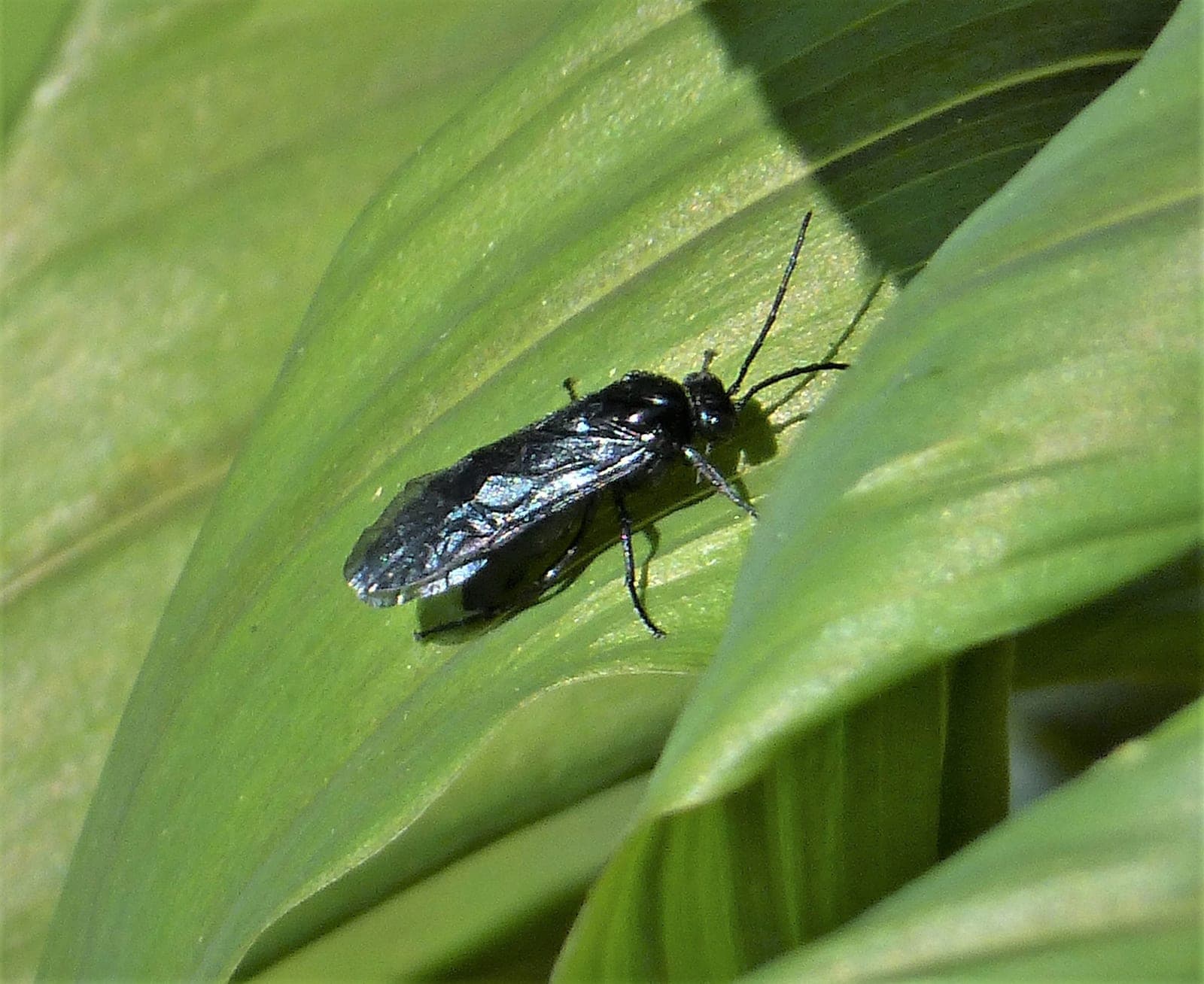
Solomon's Seal Sawfly
The Solomon's Seal Sawfly is a European sawfly, Phymatocera aterrima, that has established itself across much of northeastern North America. It is the primary insect pest of Solomon's seal (Polygonatum spp.) in ornamental gardens. Gardeners who grow these shade perennials often encounter this pest for the first time when plants that looked fine one week are stripped of foliage the next.
Adults are small, stocky, all-black, wasp-like insects that emerge in spring as Solomon's seal is unfurling. Females lay eggs directly into the leaf tissue. The larvae - pale gray-green with black heads - hatch and feed in groups, first skeletonizing leaves and then consuming them entirely. A moderate infestation can defoliate entire clumps within two to three weeks. There is one generation per year. Mature larvae drop to the soil and pupate underground, overwintering there until the following spring. Heavily defoliated plants are rarely killed, but they lose their photosynthetic capacity for the rest of the season and may produce weaker growth the following year.
A defoliating pest that targets Solomon's seal and occasionally false Solomon's seal during the spring and early summer growing season.
Grey-white larvae with dark heads feed on leaf undersides, stripping foliage to bare midribs and leaving stems skeletonized by midsummer.
Inspect leaf undersides from late spring and remove larvae by hand. Knock larvae into soapy water or apply spinosad if infestation is heavy. Plants usually recover the following year even after full defoliation.