
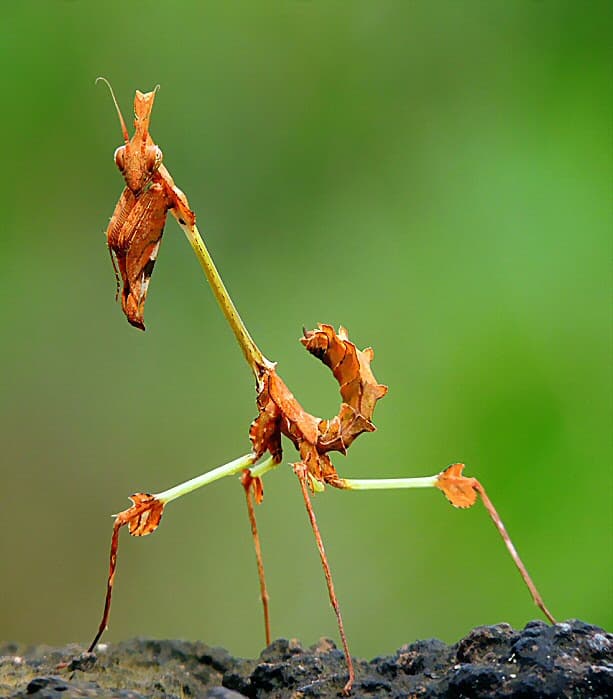
Violin Mantis
The violin mantis, also sold as the wandering violin mantis or Indian rose mantis, is one of the most elaborate mimics in the order Mantodea. The thorax is stretched into a long, narrow neck, the head carries a pointed crest, and the legs are fringed with flat, leaf-like lobes. Together they give the body a dry-leaf outline that reads as foliage rather than as an animal. The common name comes from the slender, violin-like shape of the body when it is seen from the side.
It is native to southern and southeastern Asia, including India, Sri Lanka, and parts of Indonesia and mainland Southeast Asia. Like other mantises it is an ambush predator. It holds still among the leaves, sways slightly the way a leaf moves in a breeze, and strikes with its spined forelegs when a flying insect comes within reach. Flies, moths, and other soft-bodied flying insects are typical prey.
This species belongs to the same family as the flower mantises (Hymenopodidae), not to the family that holds the praying mantis found in North American gardens. It is not part of any North American garden community, and it is not established in the wild here. It turns up in this catalog because it is widely bred and kept as a captive insect. A captive violin mantis should never be released outdoors. A non-native predator can eat native insects, and a tropical species would not survive a cold winter anyway.
Not a garden insect in North America. A tropical ambush predator kept in captivity by hobbyists, and one that should never be released outdoors.