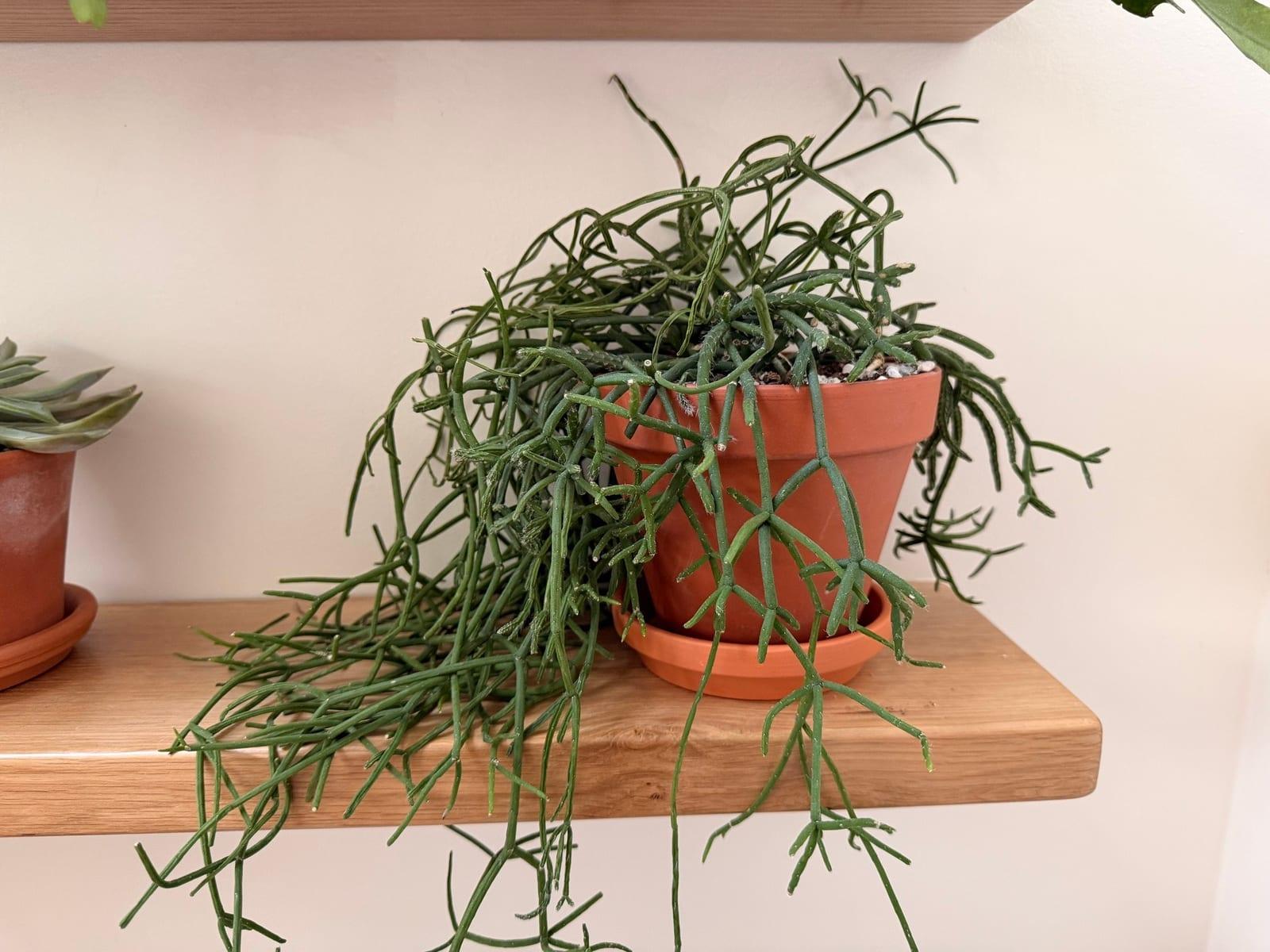
Rhipsalis baccifera is an epiphytic cactus native to tropical forests across Central and South America, the Caribbean, and Florida, where it grows on tree branches rather than in the ground. Indoors it is kept for its long, pencil-thin green stems that cascade out of hanging baskets or tall shelves, producing a dense, waterfall-like effect that is unusual among cacti. It is one of the more forgiving members of the cactus family and a solid choice for anyone who wants the architectural appeal of a succulent without intense direct sun.
Because it evolved in shaded forest canopies rather than open desert, this cactus behaves differently from what most people expect. It prefers bright indirect light over harsh direct sun, which can bleach and shrivel the stems, and it needs water more consistently than a desert cactus. The most common error is treating it like a xerophyte: letting it dry out completely and for extended periods. The top inch of the mix should dry between waterings, but the roots should not be left bone dry for weeks. Average household humidity and temperatures above 55°F suit it well, and it dislikes cold drafts.
Rhipsalis baccifera holds a notable distinction: it is the only cactus species with a native range outside the Americas, found wild across sub-Saharan Africa and into Sri Lanka. The leading theory is that migratory birds carried its berries across the Atlantic long before European contact, long enough for Old World populations to develop as distinct subspecies. At home, the plant is easily propagated by snipping a healthy stem section, letting the cut end callous for a day, and setting it in a moist mix.
Bright indirect light means a spot within a few feet of a window where the sun never strikes the stems directly; an east-facing window or a few feet back from a south or west window works well. Too little light causes etiolated, pale stems and slow growth, while direct midday sun scorches and dehydrates the stems quickly.
Water when the top inch of soil is dry; let it drain well
Feed with a balanced houseplant fertiliser
Repot only when it is crowded; it likes a snug pot
Problems & troubleshooting
Watch for
Check for mealybugs and scale along the stems