
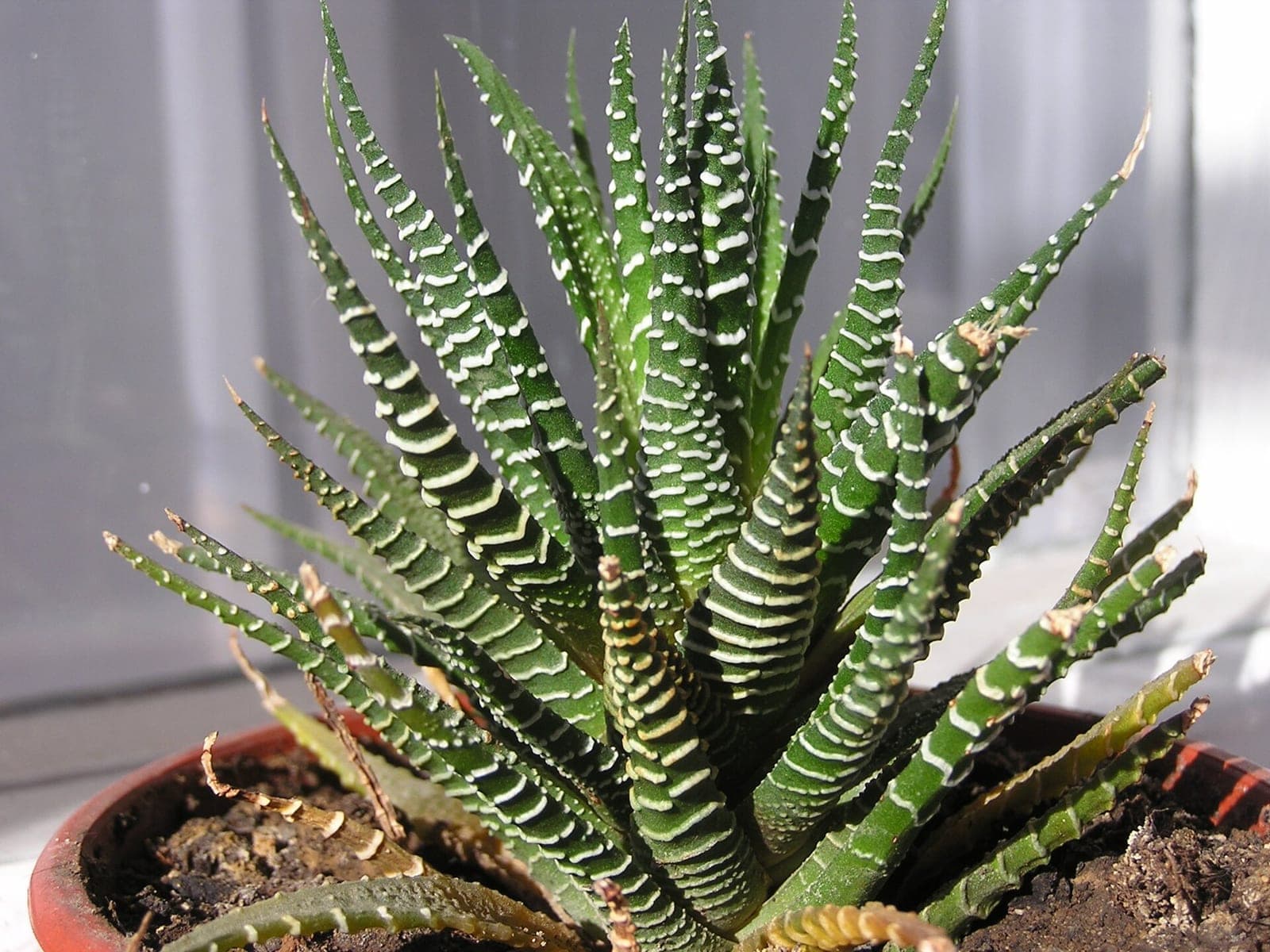
Haworthia
Zebra haworthia is a small, rosette-forming succulent native to the Eastern Cape of South Africa, where it grows in the shade of shrubs and rocks rather than in open sun. Its thick, dark green leaves are banded with raised white tubercles that give the plant its common name, and it stays compact enough to occupy a windowsill, desk, or shelf for years without outgrowing its space. These traits, combined with genuine tolerance for a degree of neglect, make it one of the most widely grown succulents in indoor collections.
The biggest mistake people make with zebra haworthia indoors is watering it too often. The plant stores moisture in its leaves and will rot at the roots if the soil stays damp for long. The potting mix should dry out completely between waterings, and the plant needs a fast-draining medium to avoid standing water. On the light side, it tolerates lower light than most succulents, but it grows best near a bright window with no direct afternoon sun, which scorches and bleaches the leaves. Indoors, temperatures between 60 and 85 degrees F suit it well, and it needs no added humidity.
Zebra haworthia offsets readily, sending up small pups around the base of the mother rosette throughout the year. Once a pup has developed a few visible roots of its own, it can be gently separated and potted individually, making propagation straightforward for beginners.
Position it within two to four feet of a bright window; bright indirect light keeps the rosette tight and the banding vivid. Too little light causes the plant to etiolate and stretch toward the source, while direct midday or afternoon sun bleaches and scars the leaves.
Soak thoroughly, then wait until the soil is completely dry
Feed with a diluted cactus and succulent fertiliser
Water far less in winter; soggy soil rots the roots
Check for mealybugs in the leaf joints
Repot into gritty mix when it outgrows the pot