
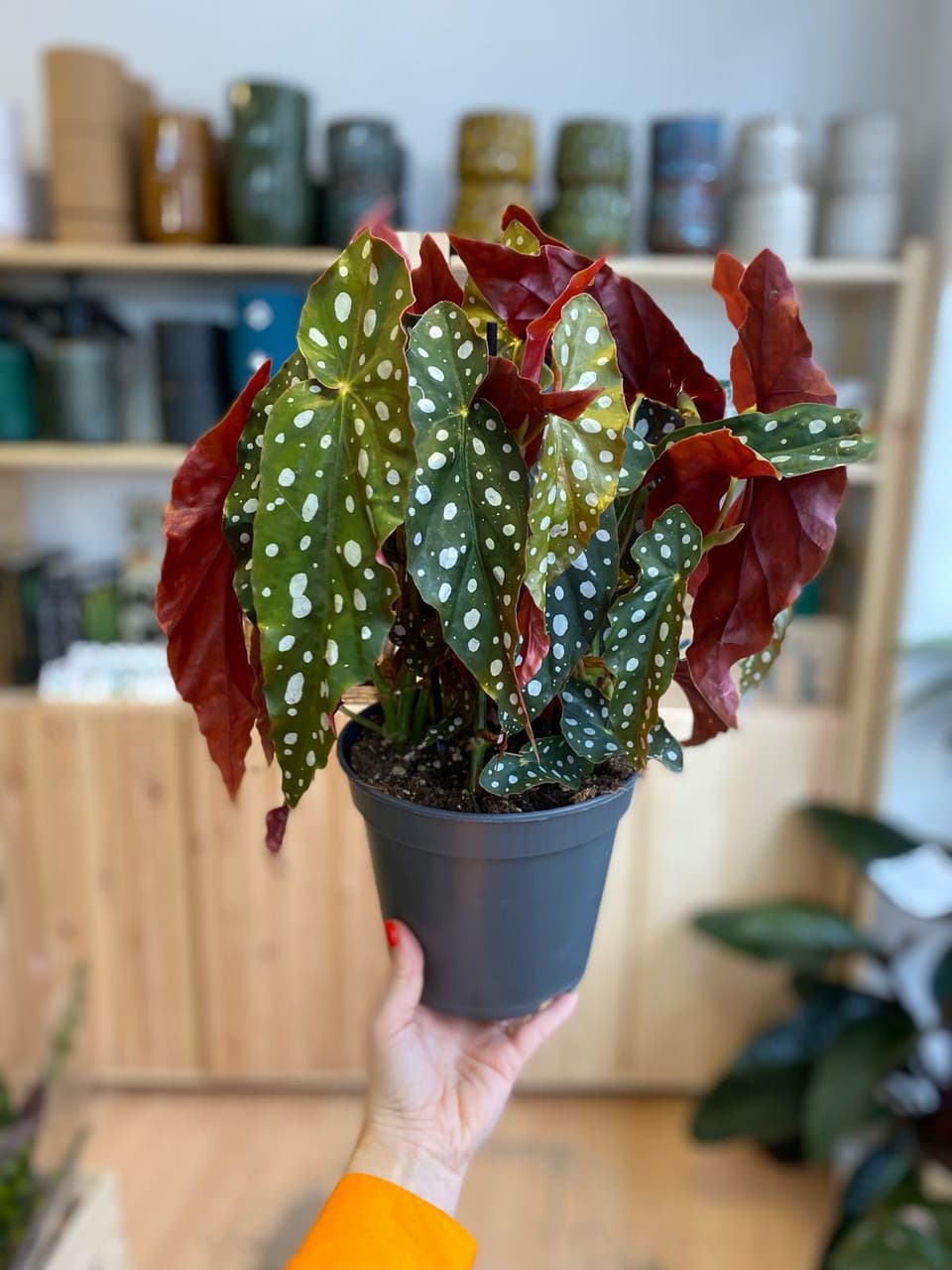
Angel-Wing Begonia
Pendant clusters come on and off through the warm months in bright indirect light; pinch the tips to keep it bushy and flowering.
Angel-Wing Begonia (Begonia maculata) is a cane-type begonia native to the understory of Brazil's Atlantic rainforest, where it grows in filtered shade beneath a dense canopy. Indoors, it is grown almost entirely for its foliage: long, asymmetrical leaves that are deep olive-green on top and covered with bright silver spots, with a rich burgundy-red underside. That combination makes it one of the more visually striking houseplants widely available, and it explains why the plant stays popular despite sitting a clear step above beginner difficulty.
Keeping it healthy indoors comes down to light and water. It needs bright, indirect light to hold its leaf color and grow at a steady pace - a dim corner will cause the canes to stretch and the spotting to lose contrast. Water when the top inch of soil has dried out, then water thoroughly and let it drain completely. The most common mistake owners make is overwatering: Begonia maculata tolerates brief drought far better than soggy soil, and root rot sets in quickly when roots sit in standing water. Average indoor humidity is adequate, but the plant dislikes being placed near heating vents or air-conditioning drafts, which dry out the leaf edges.
Given good light, this plant grows as a tall, upright cane that can reach eye level over a few years. Pinching the growing tips encourages branching and a fuller shape; without it, the plant tends to go leggy. Stem cuttings root readily in water, making propagation straightforward.
Bright indirect light means a spot within two to three feet of a south- or east-facing window, shielded from direct sun by a sheer curtain or set back from the glass. Too little light produces weak, elongated canes and dulls the silver spotting; direct midday sun causes brown, papery scorch patches on the leaves.
Water once the top inch of soil is dry
Feed with a balanced houseplant fertiliser
Wipe the leaves to remove dust and check them over
Check leaf undersides for spider mites and mealybugs
Repot when roots crowd the pot
Pinch or cut back leggy canes to keep it bushy