
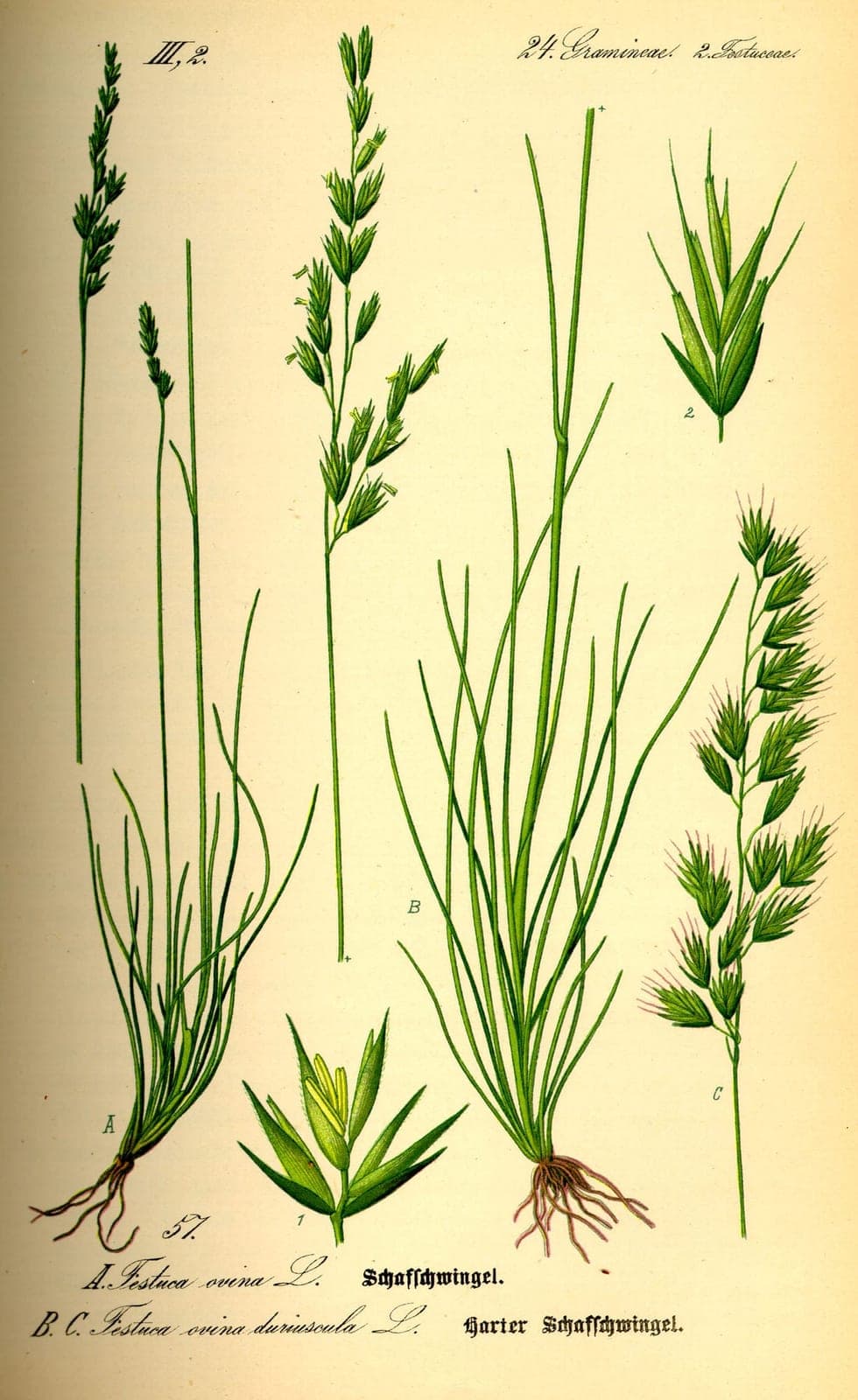
Sheep fescue is a fine-textured, cool-season bunchgrass native to Europe and widely naturalized across temperate regions. Its narrow, blue-green to gray-green leaves form dense rounded tufts and hold their color through most of the growing season. It performs reliably where most turf grasses fail - dry, infertile, sandy, or gravelly soils and sloped sites prone to erosion.
Sheep fescue grows most actively in spring and fall and often goes partially dormant during hot summers. It thrives in lean, well-drained soils and declines if over-fertilized or overwatered. Clumps tend to die out in the center as they age; dividing every 2–3 years in early spring restores vigor. A near-neutral to slightly acidic pH suits it well, and it tolerates rocky or sandy substrates that exclude more competitive species.
The dense tufts provide cover and nesting material for ground-nesting birds and overwintering insects. Sheep fescue establishes readily from seed on disturbed or eroded slopes without aggressive lateral spreading, making it a practical choice for naturalistic and low-input plantings.
Red Thread
Pink to red thread-like mycelial strands extend from leaf tips; affected blades turn tan or bleached and patches of grass appear water-soaked before drying to a straw color.
Improve drainage and air circulation around clumps. Avoid overhead irrigation, especially in the evening. Remove and dispose of heavily infected foliage. Apply a fungicide containing thiophanate-methyl or chlorothalonil if infection spreads; do not apply excess nitrogen, which favors the pathogen.
Rust
Orange to brown raised pustules on the undersides of leaves, with yellow spotting on the upper surface. Heavy infections cause leaves to yellow and drop.
Remove and destroy infected leaves. Avoid overhead watering and improve air circulation. Apply a sulfur or copper-based fungicide if it spreads. Clear plant debris in fall.
Crown Rot
Lower leaves yellow and wilt; the base of the rosette turns brown and soft, sometimes with white fungal threads at the soil line. Plants collapse in wet conditions.
Remove and destroy affected plants. Improve drainage and avoid overhead watering. Do not mulch directly against the crown. Space plants for airflow and avoid replanting in the same wet spot.