
Comfrey and the stinking jar
The single most useful plant in the garden is one you would never put in a vase, and the feed it makes smells appalling.
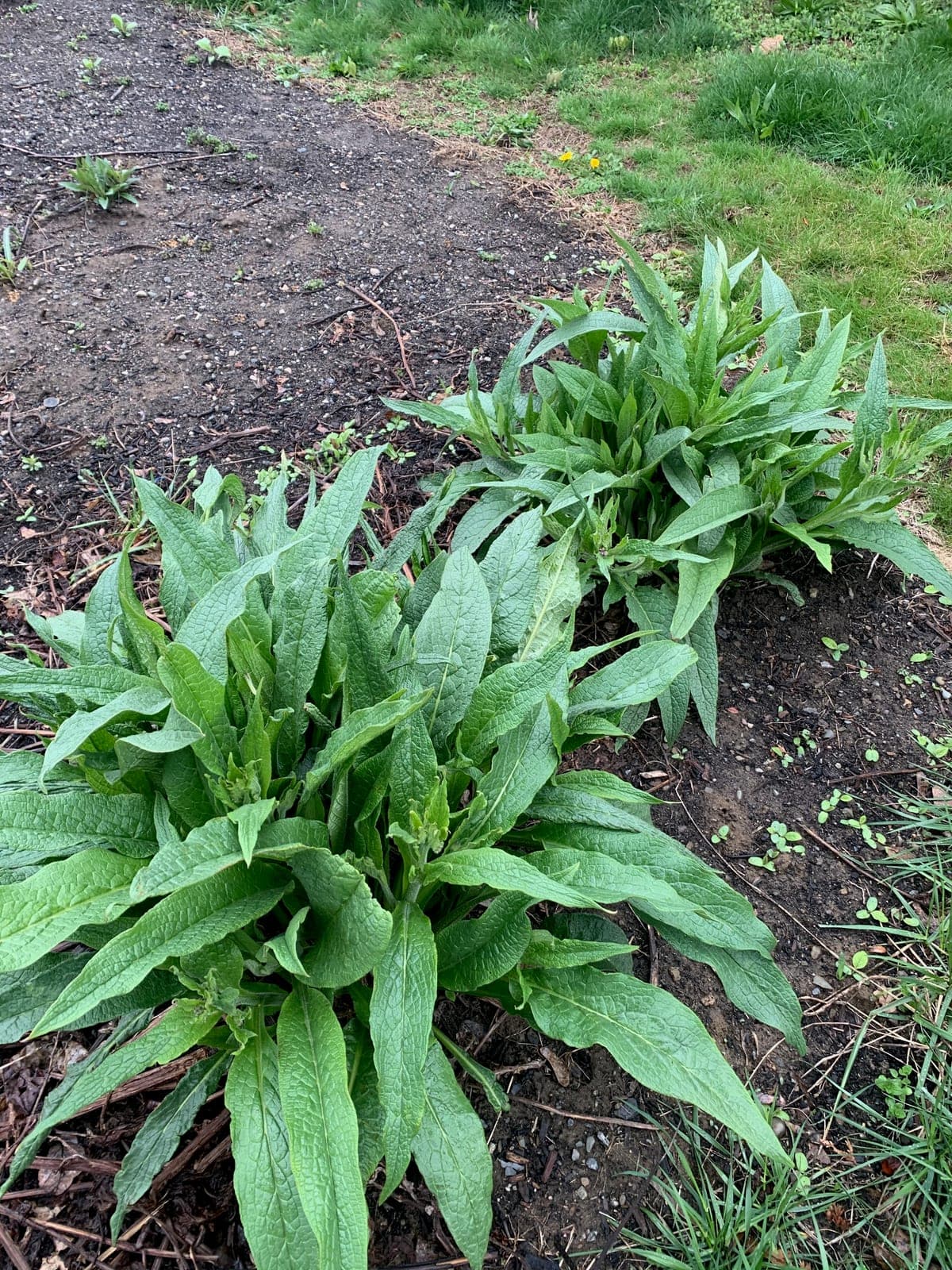
Comfrey does not belong in the cutting garden, and that is rather the point of it. It is a coarse, sprawling thing with bristly leaves and small nodding bells of lavender-pink, and you will never bring it indoors. What it does instead is work underground. The taproot drives several feet down into the subsoil, far below where most plants feed, and mines minerals — potassium above all, but also nitrogen, phosphorus, and a long list of trace elements — that it then stacks up in its leaves. A comfrey plant is, in effect, a pump that lifts fertility from the deep ground and hands it to you at the surface. The old name for plants that do this is dynamic accumulators, and comfrey is the king of them.
The simplest way to use it is to cut the leaves and lay them straight down as mulch around hungry plants — the famous chop and drop. The leaves break down fast, almost greasily, and feed the soil as they go. But the version every gardener ends up making sooner or later is comfrey tea, and a fair warning: it is one of the worst smells in the garden. You pack a bucket or a barrel with cut leaves, weigh them down, and either add water or, better, let them rot down dry into a thick black sludge over a few weeks. What comes off is a concentrate so foul that you will want it well away from the house and the neighbours. Diluted roughly ten or fifteen to one until it is the colour of weak tea, it becomes a high-potassium liquid feed that flowering and fruiting plants respond to almost greedily — tomatoes, dahlias, peppers, anything you are growing for its blooms or its fruit rather than its leaves.
Cut the leaves hard, close to the crown — a mature plant gives three or four cuttings a season, so take them freely; wear sleeves, as the bristles sting a little.
Pack them down tight into a lidded bucket or barrel, filling it, then weigh them with a brick on a board so they stay submerged as they collapse.
Choose your method. For the strong, dry version, add no water at all and let the leaves rot down into a black sludge over four to six weeks; for the quicker version, cover with water and steep for three to four weeks.
Dilute before use: the dry concentrate goes roughly one part to fifteen of water, the water steep about one to ten, until it is the colour of weak tea.
Feed at the base of flowering and fruiting plants — tomatoes, dahlias, peppers, roses — once a week through the growing season; skip leafy crops, which do not want the potassium. A batch set down this week will be ready to pour by high summer, just as the heavy feeders come into their stride. Keep the lid on and the barrel well away from the house: the smell is the price of the best free fertiliser you will ever make.
Comfrey earns its place in the compost heap, too. A few handfuls of the leaves act as an activator, heating the pile and speeding the whole thing along, and because the plant is so rich in nitrogen it helps balance out a heap that has gone too brown and woody. This is the quiet logic of a good garden: nothing is bought in if it can be grown, and fertility circulates rather than arriving in a plastic sack. Comfrey, compost, and a stinking jar of tea are most of what a productive bed actually needs.
Two cautions before you plant it. The ordinary species spreads relentlessly by both seed and root, and once it is in, it is in for good — the smallest fragment of root left in the ground will regrow. For that reason, almost everyone who grows it for feed plants the sterile cultivar 'Bocking 14', which does not set seed and stays where you put it. And site it deliberately: full sun or part shade, in a corner you are happy to give over to it permanently, ideally within easy reach of the compost heap and the beds it will be feeding. Plant it once, in the right place, and it will pay you back for decades.